A brief history
1970's-1985
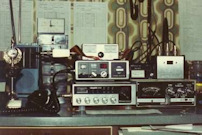
The interest for electronics had been there for quite a long time but it started to get some real shape the day I received a little transceiver on the 27 MHz band, somewhere in the beginning of the 1980's. After a short while, my objectives went further and I decided to take a chance on the examinations to become a licensed radio amateur (often referred to as a 'ham operator'), in order to get the opportunity to enlarge my possibilities. In the meanwhile my room, originally intended to be a bedroom, changed dramatically into an electronics workplace and all 'suspendable' furniture was moved to other rooms in the house.
All this resulted in achieving the call ON1BLC on the 24th of May 1985. In that era a Belgian ON1- call owner was only allowed to use all bands and all modes above 144 MHz, but not HF. Soon after a beam antenna for 2 meters was implemented on the roof and for 10 years, a lot of experimenting was done on DX-ing and trying to get some home-brewed apparatus to work properly. The purchase of a Commodore 64 allowed me to transmit in telex-mode (45.45 baud) on the 144 MHz-band and gave rise to a lot of data-transfer!
From the start of my ham period, I become a member of the local UBA section ON7LR, yielding a lot of friends in the world of hamradio. Especially Staf (ON6UA, unfortunately now silent key) who had a weekly broadcast on ATV with ON6OW (Mia), and Leo (ON6LK) have earned to be mentionned here.
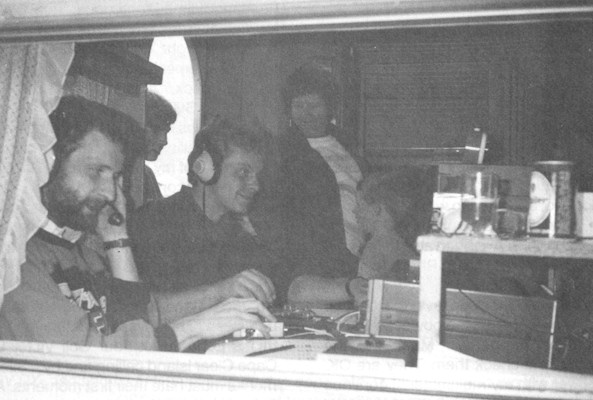
In the summer season I often joined the contest crew of ON7LR (special contest callsign OT5A) participated in the annually Field Day. In the October 1989 issue of CQ-QSO, the magazine of the UBA (koninklijke Unie van de Belgische Amateurzenders, vzw) a photo appeared of me and my ham fellowers. Click on it if you want a really huge version of it with more information).
After leaving the parental home, I moved to a new location and a brand-new shack of about 20 square meter was equipped. Near the house a 25 m high tower was erected and loaded with antennas for use on 2 m and 70 cm. When packet-radio was developed, a modem was built and coupled to the Commodore C64. The exploration of the possibilities of direct contacts and the use of bulletin boards (remember this was the pre-internet era) took a lot of time and it happened more than once that it was the upcoming sun that reminded me of getting some sleep ...
1986-2003
In the meanwhile, the really 'big' DX-work got my attention and with the help of the computer I learned the Morse code. On the 6th of November 1995, more than ten year after my first ham certificate, the call ON4CAY was dropped into the mailbox. (With a Belgian ON4- call all amateur bands may be used in all modes, finally opening all gates wide open to me).
The following years more and more equipment was home-made or buyed and the antenna tower got heavier and heavier due to all the extra antennas that were attached to it ;) You can see the evolution of my antenna park in the Gallery section.
From then on, hours and hours (a lot of them at night) were spent making DX calls on the HF bands, all in CW. Besides this, the digital modes were explored in depth, and later on even a home-brewed ATV (Amateur TeleVision) RX TX made his entry.
In 2003 (my last logged CW was on March 15th, 2003), I decided to quit this hobby for various reasons (click here if you want to know more) and the antenna installation (including the mast) and lots of the equipment was sold. Luckily some items escaped the sale.
When I moved to a new house, I spent many years renovating it and the hobby died out, so to speak. But, still being a little infected by the hamvirus, and never knowing what the future would bring, the various VHF/UHF transceivers were put away in a storage room, together with a Bearcat 9000XLT scanner I had used before to monitor some frequencies on a discone Diamond D-130, which was also still laying around. A variety of smaller things as power supplies, SWR/power meters etc found a temporary new home in several boxes. And of course, my CW keyers, especially the one that was made by my late father.
2023-...
And then a new phase came to birth: after my retirement in September 2023 I decided to find out if my old Bearcat scanner 9000XLT still worked and it did!
In my new house I decided to reserve a corner of the livingroom to be arranged as the new shack so I drilled a large hole in the wall to the adjacent garage for the antenna cables. Then I installed two aluminium masts (6 meter height each) on the back of the house. One mast got a Diamond X50N for VHF/UHF and the other a Diamond D-777 to get better airband reception of the Bearcat scanner. For the coax for both antennas I choosed Hyperflex 10 to minimize signal loss.
It soon became clear that the world of hamradio has changed dramatically since my last activities, more then 20 years earlier. On the 2 meterband and 70 centimeterbands there is almost no acitivity anymore, with the exeption of the repeaters and some weekly hamradio club talk rounds.
Browsing the internet ('Google is your friend') I gradually catched up bit by bit with the, as it soon turned out, immense evolution hamradio has been going through and in which the internet plays a very important role.
The new digital modes appealed to me since I did not have a decent antenna installation at that period and FT8 can be used with only 30 watts and a simple antenna.
That is why I bought me a Diamond WS-330S, a T2FD (Tilted Terminated Folded Dipole) which has a lenght of only about 10 meters and has a wide range from 2 to 30 MHz. It can easily be used without a tuner on the 80m - 40m - 30m - 20m - 17m - 15m - 12 m and 10m bands. And, after more than 1000 QSO's I must say it surprises me in the good sense on the tested FT8 and SSB.
For the transceiver, I choosed the well-known and widely used Icom IC-7300 which has very intuitive menus.
Finally a HP Elitedesk 800G2 Mini is used to run some hamradio software: Log4OM2, WSJTX, Gridtracker2, WfView, MMSTV etc.
Using the IC-7300 in combination with the WD-330S I soon made contacts on FT8 with more than 100 DCXX countries, and worked all continents using only about 30 watts. A new world was opening to me!
The same goes for the QSL (confirmation of a contact). Before one only used paper cards sent directly or via het national bureau. Nowadays there is a lot of (free) software available not only keep a personal logbook, but to have your contacts confirmed almost right a way via the internet. In that view I have subscribed to eQSL, QRZ.com, ClubLog and LoTW (logbook of The World). For a little amount of money you can get much more than the basics so I did not hesitate to enlarge my possibilities. For the logbook I use Log4OM2, which is very easy to use and configure.
2025
After contacting the local section LiRa (ON7LR)of the UBA I decided to take up again my membership. Surprisingly, besides some new members, I met some OM which I had knew before and a completely new board was now active.
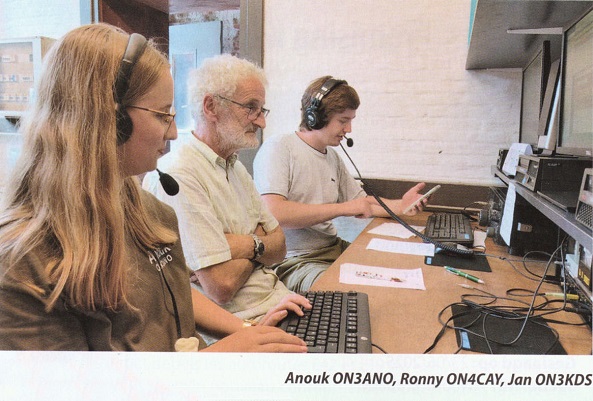
Besides the already mentionned activities, I 'participated' in the YOTA contest on July, 19th. YOTA stands for Youngsters On The Air and is meant for young radio enthousiasts who want to learn more about the hobby. According to the rules, a HAREC (Harmonized Amateur Radio Examination Certificate) licensed amateur has to be present in the shack to overlook the event and I took that role onto me with much pleasure. It even yielded some pictures of me in the September issue of CQ-QSO of which one can be seen here (click on it if you want a bigger version):
At the end of 2025, I did the same for the winter edition of the YOTA on December, 29th. One of the club members of ON7LR made a nice video of it to be seen at YOTA December 2025.
2026
This year I have the following plans:
1. buy and install a SP6CYN Hexbeam: ACCOMPLISHED! (See 'Antenna' section above).
2. buy me a base transceiver: ACCOMPLISHED! (See 'Equipment' section above).
3. pick up CW again and improving my CW skills
Let's see what can be forfilled :)