Digital modes
If you are looking for a lot of information on (DIY) hardware and software for APRS, WACARS, etc. you should: go to the 'Old website' tab above.
FT-8 using WSJT-X, Omnirig, Gridtracker2 and LoGgOM2.
Today one can say that it is mostly FT4 and FT8 that rules the digital communication on the radioamateur frequencies. Each assigned band has it dedicated frequency (given below in MHz) for FT4 and FT8:
160 m |
80 m |
60 m |
40 m |
30 m |
20 m |
17 m |
15 m |
12 m |
10 m |
6 m |
|
FT4
| 3.0575 |
7.0475 |
10.140 |
14.080 |
18.104 |
21.140 |
24.919 |
28.180 |
50.318 |
||
FT8 |
1.840 |
3.5730 |
5.357 |
7.0740 |
10.136 |
14.074 |
18.100 |
21.074 |
24.915 |
28.074 |
50.313 |
There are tons of info and youtube materials on FT4 and FT8, so it is of no use to repeat it here again, my advice is to just google on it.
I will restrict myself here to the minimum information of it but, for those interested, all my settings of WSJT-X for the Icom IC-7300 can be found below.
As I use Log4OM2 (freeware) for my logging software and GridTracker 2 (freeware) to keep track of the stations worked or actually online, you will see the corresponding links in the software settings of WSJT-X. As soon as a contact is made in FT-8, it is automatically logged in Log4OM2 with all the corresponding information of the contact.
FT8 was released for the first time in June 2017 by its developers Joe Taylor (K1JT and 1993 Noble prize winner for Physics!) and Steve Franke (K9AN) as part of the WSJT software package. It is a FSK (Frequency Shift Keying) mode that is capable of decoding very weak signals with a signal-to-noise ratio as low as -20 dB using only a very small 2500 Hz bandwidth. That allows users to communicate with very low power (30 W is considered as the maximum) and a modest antenna. It uses cycles with a duration of 15 seconds in which only mimimum information is exchanged (call, grid square locator and signal strength).
FT4 was developed in 2019 and uses a similiar but faster protocol, designed for contesting. It's cycle duration is only 7.5 seconds and the bandwidth used is 90 Hz. But, in comparison to FT8, FT4 is 3.5 dB less sensitive so it needs stronger signals (although still 10 dB lower than RTTY and using much less bandwidth).
The software used worldwide for both modes (and a few others) is WSJT-X and is open-source, so freely available to everyone.
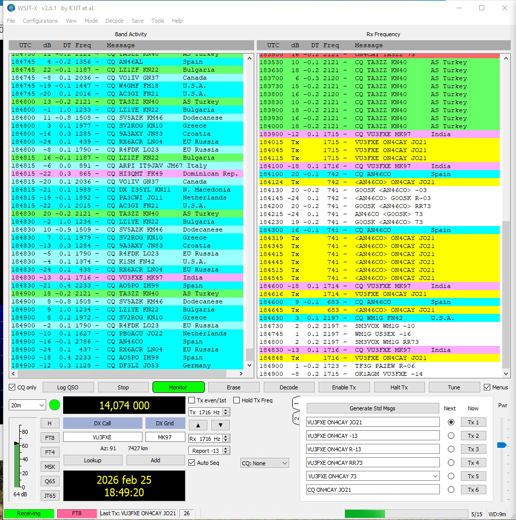
This is a typical screen of WSJT-X after 30 minutes on 20 meter (click on the picture to see it in full-screen):
There is also a separate waterfall screen to see if the frequency you are using is very busy or not. The red rectangle is the transmit frequency and the green rectangle is for the receiving frequency (click on the picture to see it in full-screen).
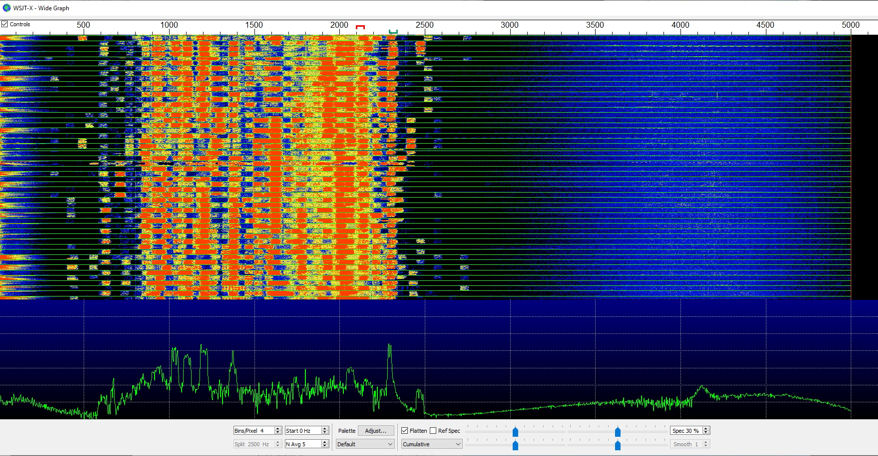
(The vertical lines separate the different 'bursts' of 15 seconds in FT8)
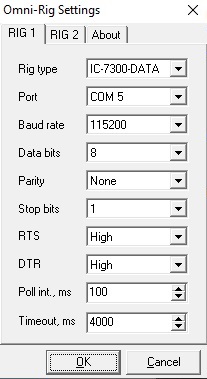
To connect the ICOM IC-7300 I use Omnirig: freeware software that makes it a lot easier and has the possibility to enter all parameters, even for 2 different transceivers, so that you don't have to enter them again when you switch to another transceiver:
 .
.
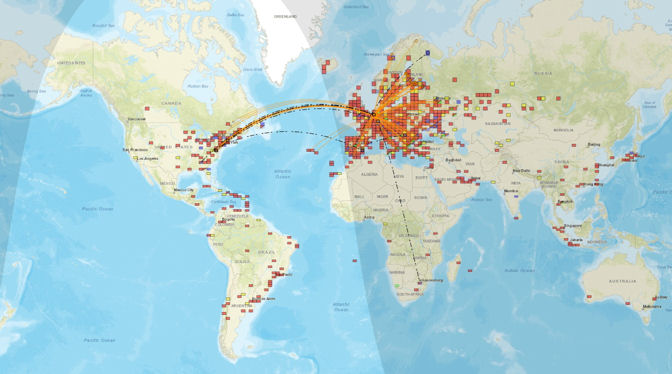
Gridtracker2 gives you a lot of useful information: the grids that are active, those who you've already worked before and the active connections, all in real-time. And in the 'statistics' tab you can visualize your score of several awards such as DXCC, WAS, WACP, etc. (Click on the picture to see it in full-screen))
As mentionned above all my settings for WSJT-X, Log4OM2 and Gridtracker 2 can be viewed by clicking on the corresponding link given below. Unrar the file(s) and you will get ALL different settings of the choosen software, screen-by-screen in .jpg format.
You will probably notice in the settings that I have a (payed) subcription for QRZ.com and eQSL.cc, and a (free) subscription on LoTW (the ARRL Logbook of The World). Log4OM2 is configured to send a new input of a QSO directly to these services. If that is not your case, just leave the corresponding fields empty.
WSJT-X settings (rar file 480 kB containing 8 screendumps)
Log4OM2 settings (rar file 4.12 MB containing 44(!) screendumps)
GridTracker2 (rar file 845 kB containing 11 secreendumps)